
What is Skip Logic in Survey Programming?

Skip logic is one of the most essential features in modern survey programming. It ensures that respondents only see questions relevant to them, improving data quality, completion rates, and overall survey experience.
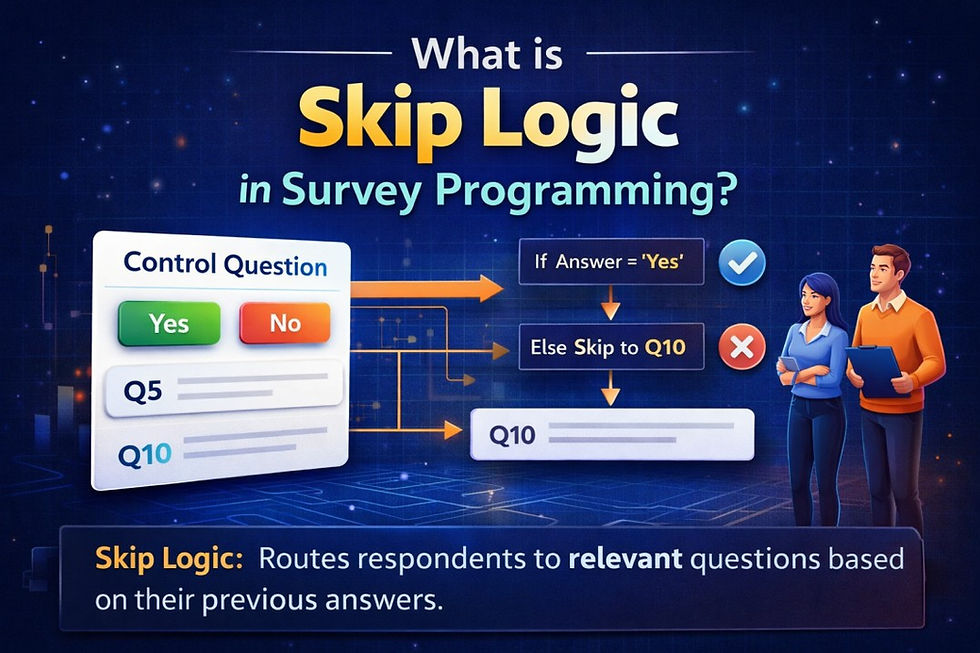
In simple terms, skip logic automatically directs respondents to different questions based on their previous answers. Instead of answering every question, users are “skipped” ahead or redirected, making surveys shorter, smarter, and more personalized.
Skip logic in survey programming is a rule-based function that routes respondents to specific questions based on their previous answers, ensuring relevant and efficient survey flow.
Why Skip Logic Matters
Without skip logic, surveys can feel long, repetitive, and irrelevant. This often leads to higher drop-off rates and poor-quality responses.
With skip logic:
Respondents only see relevant questions
Survey completion rates increase
Data accuracy improves significantly
User experience becomes seamless
For example, if a respondent answers “No” to “Do you own a car?”, skip logic will automatically bypass all car-related questions.
How Skip Logic Works
Skip logic operates using if-then conditions in survey programming.
Example:
If answer = Yes → Show Question 5
If answer = No → Skip to Question 10
This dynamic flow ensures each respondent follows a customized survey path.
Types of Skip Logic
1. Simple Skip Logic: Redirects users based on one condition. Example: Yes/No branching
2. Advanced Skip Logic: Uses multiple conditions (AND/OR logic) to create complex flows.
3. Display Logic: Shows or hides specific questions without changing the survey path.
Real-World Example
Imagine an eCommerce survey:
Q1: Have you purchased online before?
Yes → Show product experience questions
No → Skip to awareness questions
This ensures respondents only answer what applies to them, saving time and improving engagement.
Benefits of Skip Logic in Surveys
Skip logic is not just about convenience—it directly impacts business insights.
Reduces survey fatigue
Improves response accuracy
Increases completion rates
Enhances respondent experience
Enables personalized data collection
For businesses conducting market research, this leads to more reliable and actionable insights.
Skip Logic vs Branching Logic
Many people confuse skip logic with branching logic.
Skip Logic: Jumps respondents to a specific question
Branching Logic: Creates multiple survey paths based on responses
Both are used together in advanced survey programming for better control.
When Should You Use Skip Logic?
You should use skip logic when:
Your survey includes different audience segments
Not all questions apply to every respondent
You want to reduce survey length
You need more accurate and relevant data
Skip logic is a powerful feature that transforms static surveys into dynamic, respondent-friendly experiences. By ensuring that users only see relevant questions, it improves both engagement and data quality.
If you're aiming to build high-performing, user-centric surveys, implementing skip logic is not optional—it’s essential.


Comments